
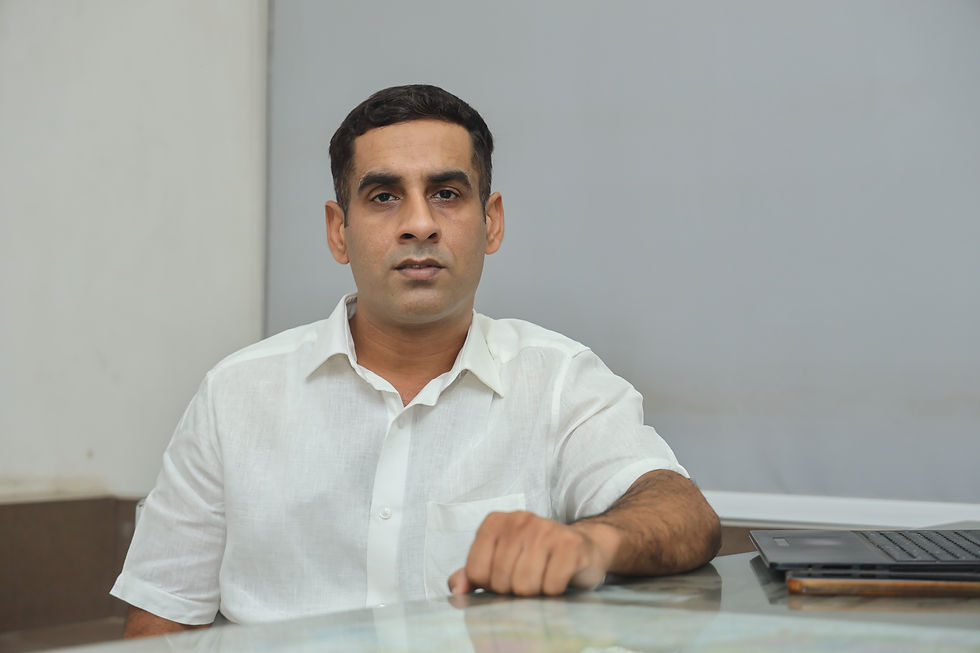
Ashok Kumar Satuluri: Transforming Sales into a Scalable Science

Ashok Kumar Satuluri’s journey into entrepreneurship did not begin with a sudden leap, but with a slow build of insight shaped by years of working across both technology and sales. That dual exposure gave him a clear view into a problem many companies quietly struggled with. Strong technical teams were everywhere, yet business growth often stayed inconsistent and unpredictable. The gap was not capability, it was conversion. That realization stayed with him until it turned into a clear direction for what would later become Thespan Outsourcing Pvt Ltd.

What shifted everything for him was not just spotting that gap, but acting on it with conviction. He saw that sales in IT services lacked structure and depth, often treated as a secondary function rather than something central to growth. From that insight came the idea of Sales as a Service, a model he did not just theorize but built and tested in real conditions. When it started delivering results, the decision to move beyond a traditional role felt less like a risk and more like a natural next step. The transition came from ownership of an idea that worked, not just belief in it. The early days brought clarity, but also a few hard truths. One of the biggest lessons was simple yet uncomfortable. A strong plan does not automatically lead to results. Execution depends on people, discipline, and patience, and those elements rarely fall into place quickly. Hiring the right talent and building consistency across teams turned out to be far more challenging than expected. There was also the added reality that new business models take time before clients begin to trust them.
He sums up that phase with a line that stayed with his team, “Strategy looks powerful on paper, but execution is what decides everything.” That shift in thinking changed how the company operated. More focus went into training, structured systems, and long term consistency instead of chasing quick wins that rarely sustain.

Over time, the company carved its own identity in a crowded IT services space by placing sales at the center of business growth rather than treating it as support. The work was not just about filling pipelines, but about building relevant ones that matched delivery strengths. Everything was system driven, from messaging to conversions, which reduced dependency on individual performance and brought consistency into outcomes.
This clarity also shaped how innovation was handled inside the company. Instead of chasing every new idea, the focus stayed on ideas that strengthened execution. New methods were tested in controlled environments, measured carefully, and scaled only when they proved useful. Alignment between sales and delivery remained a constant priority, since any disconnect there would weaken results. Clients, in his view, care less about ideas and more about what those ideas actually deliver.

Leadership, too, went through its own transition. In the beginning, he was deeply involved in almost every aspect of the business. That approach worked for a while, but started to show its limits as the company grew. The shift from being a doer to building leaders within the team became necessary. Today, his focus sits more on direction and accountability, allowing systems and people to handle execution without constant intervention.
Hiring brought its own set of lessons, some of them unexpected. Early decisions leaned toward experienced candidates, assuming faster output. That assumption did not always hold true. Many struggled to adapt to structured sales systems, while less experienced but coachable individuals often delivered better results over time. “Skills can be taught, but mindset and ownership are harder to build,” he says, a belief that now shapes how hiring decisions are made.
His perspective on Indian tech companies carries both pride and concern. Execution strength is undeniable, yet positioning, differentiation, and storytelling often fall short on a global stage. Many companies still try to serve too many segments instead of building depth in a specific domain. Sales, when undervalued, leads to inconsistent pipelines and pricing pressure, which limits long term growth.

Even with these challenges, the future holds strong shifts that excite him. The movement toward AI driven systems and software that executes tasks rather than just assisting is changing how businesses operate. Sales is becoming more transparent, measurable, and data driven, which brings sharper decision making into everyday operations. If he were to start again, he would lean into a SaaS first model from day one, bringing visibility and accountability into every stage of the sales cycle.
Beyond business outcomes, his focus stays on something more lasting. He wants to change how sales is perceived in the IT services space, moving it from an individual driven effort to a structured and respected discipline. The larger aim is to build a generation of professionals who understand not just targets, but also technology, business thinking, and human behavior. A system that continues to function long after the company grows beyond its current form.



Comments